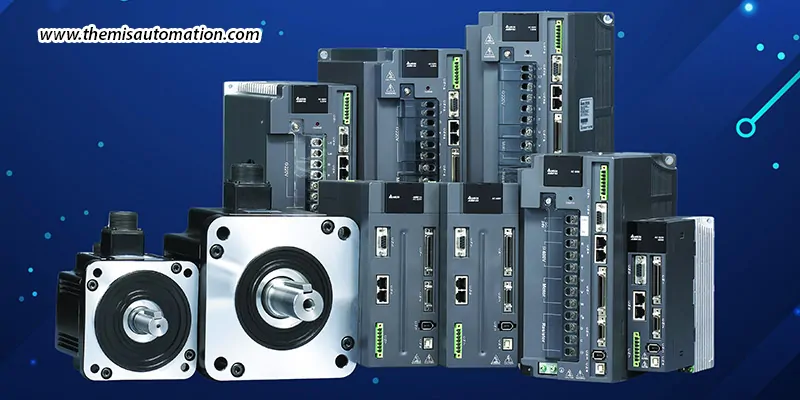
In the current industrial environment, precision has transitioned from being a luxury to an essential requirement. Whether in CNC machining, robotics, packaging, or semiconductor production, modern automation necessitates accurate positioning, swift response, and reliable motion control. At the heart of this precision-focused ecosystem is a formidable duo: AC servo drives and servo motors. AC servo drives serve not merely as power devices; they function as intelligent controllers that perpetually monitor, adjust, and enhance motor performance in real time. Their capability to provide precise control over position, speed, and torque renders them vital in high-performance automation systems. This blog delves into the workings of AC servo drives and, more significantly, how they facilitate high-precision motion in contemporary automation settings.
What is an AC servo drive?
An AC servo drive acts as a controller that powers and regulates a servo motor within a closed-loop motion control framework. Unlike traditional motor drives, it does not merely deliver power; it continuously processes feedback and corrects motion in real time. Fundamentally, a servo drive:
- Receives command signals (position, speed, torque)
- Converts electrical power into controlled output
- Monitors feedback from sensors (such as encoders)
- Instantly adjusts performance to uphold accuracy
This ongoing feedback-driven correction is what enables servo systems to attain exceptionally precise motion.
How AC servo drives work
To understand precision, it is important to understand how an AC servo drive works.
- Signal processing and control: Servo drives use advanced digital processors to decode control signals and implement intricate motion algorithms.
- Power conversion (AC–DC–AC): The drive transforms incoming AC power into DC and subsequently converts it back into regulated AC output designed for the motor.
- Closed-loop feedback system: An encoder or resolver consistently transmits real-time information regarding position, speed, and direction back to the drive.
- Real-time error correction: The drive assesses actual performance against the intended command and promptly rectifies any discrepancies.
This ongoing loop guarantees that the motor’s movement remains precise—even when faced with varying loads or disturbances.
How AC servo drives achieve precision
Modern industries are under growing demands for increased productivity, reduced errors, consistent quality, and quicker cycle times. In such settings, even slight inaccuracies can result in defective products, material waste, and heightened downtime. Servo systems tackle this issue by providing repeatable, dependable, and high-speed precision. Here’s how:
- Closed-loop control for real-time accuracy
The primary benefit of AC servo drives is their closed-loop control system. In contrast to open-loop systems (such as stepper motors), servo drives continuously oversee motor output, detect deviations immediately, and correct errors in real time. This guarantees near-zero positioning errors, high repeatability, and stable performance even amid load fluctuations.
- Multi-parameter control
AC servo drives manage motion across three essential parameters – precision control, speed control, and torque control, all of which ensure accurate placement, consistent velocity, and regulated force output. This multi-faceted control enables machines to execute complex tasks with remarkable accuracy.
- High-speed response and dynamic performance
Modern servo drives are engineered for swift responsiveness. They provide rapid acceleration and deceleration, quick settling times, and minimal lag. Additionally, sophisticated control algorithms enhance system responsiveness and decrease delays, facilitating faster and smoother motion. This is especially crucial in scenarios where timing is essential, movements are repetitive, and speed and accuracy must be balanced.
- Advanced control algorithms
Servo drives employ advanced algorithms to enhance stability, diminish vibration, minimize tracking errors, and compensate for mechanical flaws. These algorithms improve motion smoothness, system reliability, and overall performance. Certain systems can even attain exceptionally fine precision through high-speed sampling and sophisticated control logic.
- Encoder feedback for accurate positioning
Encoders deliver real-time information on position, speed, and direction. Servo drives utilize this information to compare actual motion against commanded motion and adjust output immediately. This feedback system guarantees accurate positioning, consistent repeatability, and minimal deviation. Without encoder feedback, achieving high-precision control would be unfeasible.
- Smooth motion and reduced vibration
AC servo systems are designed to provide smooth, controlled rotation with minimal vibration and highly stable torque output. In contrast to traditional motors, they eliminate jerky movements, lessen mechanical wear, and enhance overall machine stability, ultimately improving product quality and consistency in precision-driven industrial applications.
- High power density and efficiency
AC servo motors integrate high torque output with effective energy use in a compact design. Their capacity to provide robust performance while minimizing power consumption makes them suitable for challenging automation settings, guaranteeing precision, dependability, and enhanced machine performance even in limited industrial spaces.
- Multi-axis synchronization
In sophisticated automation systems, it is essential for multiple motors to function in perfect harmony to accomplish intricate tasks. Servo drives facilitate accurate multi-axis synchronization, ensuring smooth motion control across various components. This coordinated operation improves accuracy, decreases errors, and enables machines to perform complex tasks with high efficiency and consistency.
Applications where precision servo drives make a significant impact
AC servo drives are extensively utilized in scenarios that require high precision and rapid responsiveness within contemporary automation systems.
- CNC machines gain from accurate tool positioning, smooth cutting trajectories, and exceptional repeatability, which guarantees uniform machining quality.
- In the field of robotics, servo systems facilitate precise movements, real-time adaptability, and high-speed performance for dynamic tasks.
- Packaging machinery depends on synchronized operations, consistent output, and minimized errors to enhance efficiency.
- In semiconductor manufacturing, servo drives enable ultra-precise positioning with clean, vibration-free motion.
- Automated assembly lines realize repeatable motion cycles and increased productivity.
Their capability to provide precise, dependable motion control renders servo drives indispensable in these applications.
Integration in modern automation systems
AC servo drives are engineered for seamless integration with PLC systems, HMI interfaces, and industrial communication protocols, promoting efficient and coordinated machine operations. They facilitate real-time monitoring, intelligent control, and data-driven automation, empowering industries to enhance performance and minimize downtime. This sophisticated level of integration positions servo drives as a vital element in contemporary smart factories and Industry 4.0 settings, where precision, connectivity, and operational efficiency are crucial for achieving scalable and future-ready automation systems. For businesses aiming to adopt such advanced motion control solutions, partnering with a trusted Delta automation distributor in Ahmedabad Gujarat guarantees access to authentic servo drives, expert advice, and smooth system integration assistance.
AC servo drives serve as the foundation for high-precision motion in contemporary automation, allowing industries to attain remarkable accuracy and control. By integrating closed-loop systems, real-time feedback, sophisticated algorithms, and swift response capabilities, they guarantee consistent and dependable performance. Their capacity to accurately manage position, speed, and torque renders them essential in scenarios where even minor deviations can impact quality and productivity. As automation technologies progress, AC servo drives will continue to be pivotal to innovation, facilitating smarter, quicker, and more efficient industrial processes. In a world driven by precision, they transcend mere functionality, acting as crucial enablers of operational excellence and enduring reliability.