Industrial automation in the present day relies on the smooth exchange of data among machines, controllers, sensors, and digital systems. As industries transition to smarter manufacturing, effective communication has become crucial for operational efficiency. Industrial Ethernet facilitates high-speed, secure, and stable connectivity, even in environments challenged by electrical interference, vibration, and temperature fluctuations. Within the LAPP product range, ETHERLINE® cables are specifically engineered for Industrial Ethernet applications, ensuring reliable communication between automation systems and equipment. This blog delves into the significance of ETHERLINE® cables in smart factories, highlighting their essential features, advantages, and their role in contemporary industrial communication networks.
Why industrial ethernet matters in today’s landscape
Manufacturing has entered a phase where data holds equal value to production itself. Each machine, sensor, PLC, drive, and monitoring device produces information that aids businesses in enhancing efficiency, minimizing downtime, and optimizing operations. To facilitate this continuous flow of information, industrial communication networks must ensure high-speed data transfer, dependable real-time communication, minimal latency, stable network performance, and scalability for future growth. Conventional communication systems frequently fall short of these demands in industrial environments, as they are not built to endure harsh conditions. Industrial Ethernet overcomes these obstacles by integrating Ethernet technology with robust components capable of functioning in challenging manufacturing settings. This has established Industrial Ethernet as the preferred communication standard for industries undergoing digital transformation.
How Industrial Ethernet differs from commercial Ethernet
While Industrial Ethernet is founded on standard Ethernet technology, its design focuses differ markedly from that of commercial Ethernet. Commercial Ethernet networks are mainly intended for office communication, file sharing, and general IT infrastructure, where minor delays or occasional interruptions have minimal impact. Conversely, industrial settings necessitate communication systems that can support real-time machine control, production monitoring, motion control, robotics, safety systems, and continuous process automation. A brief communication failure in these environments can disrupt production, compromise product quality, or halt an entire manufacturing line. Consequently, Industrial Ethernet cables must possess enhanced mechanical strength, superior shielding, and reliable performance under demanding conditions.
What are ETHERLINE® cables?
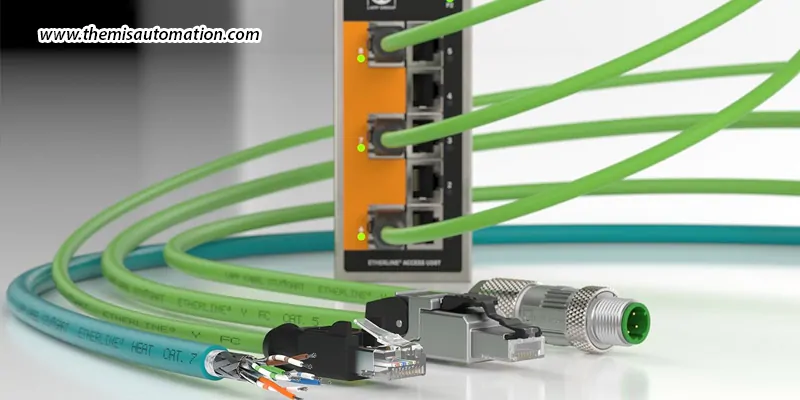
ETHERLINE® cables represent industrial Ethernet solutions that ensure reliable and high-performance data communication within automation systems. In contrast to standard Ethernet cables used in commercial settings, ETHERLINE® cables are specifically designed to endure the rigorous conditions found in industrial applications. They are constructed to function reliably in environments subject to continuous machine operation, mechanical vibrations, electromagnetic interference (EMI), exposure to oils and chemicals, temperature variations, and frequent movement. With their robust design and application-specific features, these cables facilitate stable data transmission and reduce communication interruptions. Their capability to maintain consistent connectivity makes them a vital component for contemporary automation systems, smart factories, and Industrial Ethernet networks that demand reliable performance in challenging operational environments.
Key features of ETHERLINE® cables
Industrial communication systems require not only rapid data transfer but also cables that can ensure reliable performance over years of continuous use.
- High-speed data transmission
ETHERLINE® cables are engineered to facilitate high-speed communication among industrial devices, allowing for immediate system responses, quicker machine interactions, real-time monitoring, and enhanced production efficiency.
- Excellent signal integrity
ETHERLINE® cables are crafted to preserve outstanding signal quality, which helps minimize transmission errors and guarantees reliable communication between connected devices.
- Mechanical durability
ETHERLINE® cables are designed to endure constant vibration, mechanical stress, abrasion, and frequent movement, thereby promoting long-term network reliability and decreasing maintenance needs.
- Protection against Electromagnetic Interference
Industrial environments often have numerous sources of electromagnetic interference that can disrupt communication signals. ETHERLINE® cables feature shielding that reduces EMI, thereby enhancing network stability and communication reliability.
Benefits of ETHERLINE® cables for modern manufacturing
The reliability of Industrial Ethernet networks is directly linked to the quality of their supporting infrastructure. Selecting high-quality Ethernet cables presents numerous long-term benefits for industrial operations.
- Enhanced network reliability
Effective communication is essential for all automated processes. ETHERLINE® cables ensure stable network performance, minimizing communication disruptions that could hinder production.
- Accelerated data transfer
Rapid communication facilitates quicker interactions between machines and control systems, enabling production processes to function more efficiently and accurately.
- Increased productivity
Reliable communication reduces delays, limits system interruptions, and promotes continuous production, allowing facilities to optimize their operational efficiency.
- Lower maintenance requirements
Robust cable construction is designed to endure mechanical stress and challenging industrial conditions, leading to less frequent cable replacements and maintenance.
- Stronger support for digital transformation
As manufacturers increasingly embrace smart technologies, the significance of Industrial Ethernet networks grows. ETHERLINE® cables offer a reliable communication framework that can accommodate expanding automation needs and future technological innovations.
How ETHERLINE® cables support smart factories
ETHERLINE® cables establish the essential physical communication framework that facilitates uninterrupted interaction among equipment, software, and personnel – an essential requirement in smart factories.
- Machine-to-machine communication
Contemporary machines must exchange information regarding their status, performance, and operating conditions to collaborate effectively. Dependable Industrial Ethernet cabling enables machines to share data swiftly and continuously, ensuring seamless production processes free from communication delays or interruptions.
- Industrial IoT connectivity
The Industrial IoT links machines, sensors, and digital platforms to gather and analyze production data. ETHERLINE® cables bolster these interconnected networks by guaranteeing dependable data transfer, aiding manufacturers in enhancing visibility, monitoring operations, and making informed decisions.
- Real-time monitoring
Manufacturers employ real-time monitoring to oversee machine performance, production output, energy consumption, and equipment conditions. Industrial Ethernet networks facilitate continuous data communication, enabling operators to swiftly detect issues, enhance efficiency, and sustain smooth production operations.
- PLC communication
PLCs manage automated machines by interfacing with sensors, drives, actuators, and other systems. ETHERLINE® cables ensure stable connections among these devices, allowing PLCs to receive precise information and transmit control signals for efficient and reliable automation operations.
- Remote diagnostics and predictive maintenance
Industrial Ethernet networks assist maintenance teams in monitoring equipment conditions and detecting potential issues early on. With reliable communication provided by ETHERLINE® cables, manufacturers can conduct remote diagnostics, reduce unexpected failures, enhance equipment reliability, and minimize downtime.
Choosing the right ETHERLINE® cable
Choosing the right Industrial Ethernet cable requires more than just matching connector types. It is essential to evaluate several application-specific factors to guarantee long-term network reliability.
- Installation environment
Determine if the cable will be used indoors, outdoors, within machinery, or in harsh industrial settings that may be exposed to moisture, oil, chemicals, or extreme temperatures.
- Mechanical requirements
For applications that involve continuous movement, vibration, or drag chains, it is crucial to select cables that are specifically engineered to endure repeated mechanical stress.
- Data transmission requirements
The necessary communication speed, bandwidth, and network architecture must correspond with the cable specifications to ensure dependable data transfer.
- Electromagnetic Interference
In environments with significant electrical noise, it is advisable to opt for shielded cable variants that offer improved protection against electromagnetic interference.
For businesses looking to plan or upgrade their Industrial Ethernet networks, collaborating with a reliable LAPP distributor in Ahmedabad Gujarat, such as Themis Automation, can streamline the selection process by providing access to authentic LAPP connectivity solutions and expert advice on choosing the right ETHERLINE® cables tailored to specific industrial applications.
As manufacturing evolves into a more interconnected landscape, effective communication becomes crucial for operational efficiency. Industrial Ethernet facilitates real-time data exchange among machines, controllers, sensors, and monitoring systems, thereby enhancing productivity and decision-making processes. ETHERLINE® cables, engineered for demanding industrial settings, provide high-speed data transmission, reliable signal integrity, and robust durability for automation systems. They are suitable for various applications, including factory automation, robotics, process industries, and smart manufacturing. By establishing a reliable Industrial Ethernet infrastructure, companies can enhance connectivity, minimize downtime, and develop scalable networks that are prepared to accommodate future digital transformations and changing industrial requirements.