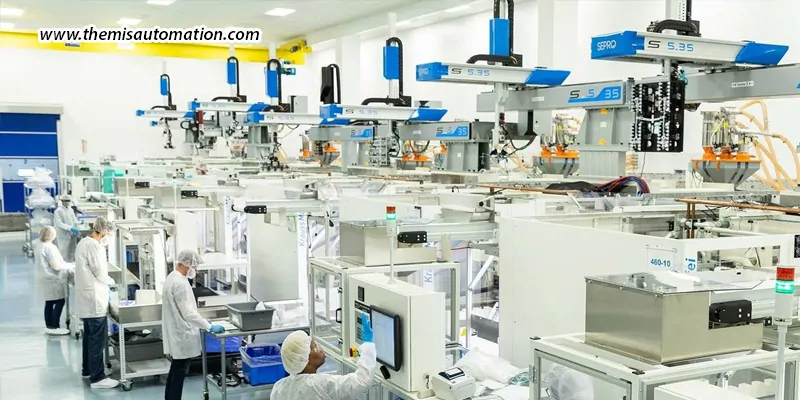
Consistency is essential for ensuring product quality, regulatory compliance, and patient safety in the pharmaceutical manufacturing industry. Every batch must meet strict standards for composition, potency, and performance, making precision a critical requirement throughout production. Traditional manual processes often introduce variability through human error, environmental fluctuations, and inconsistent handling. Pharma automation helps overcome these challenges by improving process control, reducing deviations, and enhancing operational accuracy. Technologies like automated dosing systems, SCADA platforms, real-time monitoring, and intelligent process controls enable manufacturers to maintain uniform production conditions. As a result, automation supports better batch consistency, improved traceability, higher efficiency, and stronger manufacturing reliability.
Understanding batch consistency in pharmaceutical manufacturing
Batch consistency refers to the ability to produce pharmaceutical products with uniform quality characteristics across multiple production cycles. This includes maintaining consistency in:
- Active ingredient concentration
- Product weight and volume
- Dissolution and stability profiles
- Mixing uniformity
- Sterility and contamination control
- Packaging accuracy
- Environmental conditions during manufacturing
Consistency is essential because patients expect every dose of medication to perform identically, regardless of when or where it was manufactured. Regulatory authorities thus require pharmaceutical manufacturers to demonstrate that products are consistently produced and controlled as per predefined quality standards.
Why maintaining consistency is difficult
While consistency is a crucial aspect of pharmaceutical manufacturing, it becomes difficult to maintain the same consistency across every batch, especially if the entire process is dependent on manual labour only. This is because as production scales grow, formulations become more complex, and manufacturing processes involve multiple stages and variables, there could be data recording errors, operator variations, inconsistent process timing, improper equipment calibration, and environmental fluctuations. But, when manual labour processes are replaced with automation, these challenges can be addressed by standardizing processes and enabling tighter process control.
The shift toward automated pharmaceutical manufacturing
Realizing how manual labour alone can bring up so many challenges, the pharmaceutical industry has now evolved to introduce automated processes in manufacturing. Automation technologies now play a central role in modern pharmaceutical facilities, supporting operations like:
- Raw material handling
- Granulation and blending
- Tablet compression
- Liquid filling
- Sterile processing
- Packaging and labelling
- Inspection and rejection systems
- Environmental monitoring
- Batch reporting and documentation
By integrating automated systems throughout the production line, manufacturers can create highly controlled environments where every process parameter is continuously monitored and optimized.
The benefits of automated pharmaceutical manufacturing processes
- Human error is reduced
Human error remains one of the most common causes of batch inconsistencies in pharmaceutical manufacturing. Manual operations can introduce variations in measurements, timing, equipment setup, and documentation. But, with automation, systems can execute predefined instructions with a high degree of precision and repeatability. Whether it is dispensing ingredients, controlling mixing durations, or monitoring filling volumes, automated equipment performs tasks consistently without fatigue or subjective decision-making. Reducing reliance on manual intervention helps maintain uniform production conditions across batches, leading to improved product quality and fewer rejected lots.
- There is utmost precision in material handling and dosing
Even the slightest variations in ingredient quantities can affect the potency, safety, and performance of pharmaceutical products. Automation improves precision in several areas like weighing, dispensing, and transfer systems. Automated weighing systems reduce inconsistencies caused by manual measurement errors by using calibrated sensors and digital controls to ensure accurate material quantities; automated dispensing systems precisely deliver active ingredients and excipients as per validated recipes to maintain formulation accuracy; and automated transfer systems move materials between processing stages, while minimizing contamination risks and product loss.
- Mixing and blending becomes uniform
Uniform mixing is critical in pharmaceutical manufacturing, especially for tablets, capsules, powders, and suspensions. Inconsistent blending can lead to uneven distribution of pharmaceutical ingredients, resulting in dosage variations between products. Automated mixing systems improve consistency by controlling variables like mixing speed, rotation patterns, processing time, material feed rates, and temperature. By maintaining stable and repeatable mixing conditions, automation helps manufacturers produce batches with uniform composition and performance characteristics.
- Real-time monitoring and process control is possible
One of the most valuable advantages of pharma automation is the ability to monitor production processes in real time. Automated systems continuously collect and analyze operational data from sensors, controllers, and production equipment, enabling manufacturers to identify deviations immediately instead of discovering issues after batch completion. The key parameters that can be monitored include temperature, pressure, humidity, environmental conditions, mixing speed, flow rates, filling accuracy, and equipment performance. Such real-time monitoring improves batch consistency by enabling immediate corrective actions, faster deviation detection, and reduced process variability, while promoting stable operating conditions and better equipment synchronization.
- Quality is controlled
Traditional manual inspection methods can be time-consuming and subjective. Automated inspection systems use cameras, sensors, and machine vision technologies to evaluate products with greater speed and accuracy. These systems can detect tablet defects, missing components, foreign particles, incorrect fill levels, packaging defects, and labelling errors. Moreover, automated rejection systems can immediately remove defective products from the production line, preventing quality issues from affecting entire batches. Such consistent inspection standards help manufacturers maintain uniform product quality across high-volume production runs.
- Regulatory compliance is strengthened
Authorities such as the FDA and global regulatory agencies require manufacturers to demonstrate consistent production processes, validated systems, and reliable documentation practices. Automation helps manufacturers meet these requirements through controlled production environments, standardized operating procedures, reduced process variability, automated data recording, enhanced traceability, and real-time deviation monitoring. Automated systems also provide accurate digital records and detailed operational histories. As regulatory expectations continue to evolve, automation is becoming increasingly important for maintaining compliance and operational transparency.
The role Of SCADA And PLC systems
SCADA (Supervisory Control and Data Acquisition) and PLC (Programmable Logic Controller) systems form the backbone of modern pharmaceutical automation.
- SCADA systems
SCADA platforms provide centralized monitoring and control capabilities. Operators can use SCADA systems to track process performance, monitor alarms and events, analyze production trends, generate reports, and manage recipes and batch data.
- PLC systems
PLCs control machinery and execute automated production sequences. They ensure that equipment operates as per predefined logic and process parameters. They help maintain consistency by automating repetitive tasks, synchronizing equipment operations, reducing timing variations, and improving process reliability.
Together, SCADA and PLC systems create integrated manufacturing environments that support stable and repeatable production processes. Modern automation companies such as Themis Automation support pharmaceutical manufacturers with integrated SCADA, PLC, and pharma automation solutions that help improve operational visibility, process control, and batch consistency across production environments.
Batch consistency is a critical requirement in pharmaceutical manufacturing, where quality, safety, and regulatory compliance must be maintained at every stage of production. Pharma automation helps manufacturers achieve greater precision, reliability, and process control through technologies such as real-time monitoring, automated material handling, digital documentation, and advanced inspection systems. These solutions reduce variability between batches while improving efficiency, traceability, and equipment performance. Automation is becoming increasingly important for maintaining operational stability and consistent product quality today. It is viewed as a strategic investment essential for modern pharmaceutical manufacturing success.