In the world of industrial automation, programmable logic controllers (PLCs) are essential for managing processes, machinery, and manufacturing systems. Siemens, a prominent name in automation technology, provides a range of PLCs tailored for various applications, levels of complexity, and scalability needs. The S7‑1200, S7‑1500, and S7‑200 SMART series are among the most widely used. Understanding the differences, and the functionalities and optimal applications of each, can assist engineers, system integrators, and automation professionals in making well-informed choices for their projects.
What is a Siemens PLC?
A Siemens PLC is a digital computing device utilized for automating industrial processes, such as controlling machinery on factory assembly lines, amusement park rides, or lighting systems. Unlike standard computers, PLCs are specifically designed for real-time control, dependability, and durability in challenging industrial settings. Siemens PLCs are highly regarded for their efficiency, modular design, and compatibility with Siemens automation solutions like HMI panels, I/O systems, and SINAMICS drives. They also support a variety of communication protocols, including PROFINET, PROFIBUS, and Ethernet/IP, facilitating smooth connectivity within contemporary industrial networks.
Why choose a Siemens PLC?
Siemens PLCs are favoured for their reliability, longevity, and extensive variety of options to choose from, facilitating seamless integration within the Siemens automation ecosystem. With global support that includes comprehensive technical documentation, training, and community resources, these PLCs cater to industries ranging from manufacturing and packaging to water treatment and building automation. For businesses and system integrators in India, procuring from a reputed Siemens distributor in Ahmedabad guarantees access to genuine Siemens PLCs, along with complementary automation solutions, which enable smooth and efficient project execution.
Overview of Siemens PLC Series
Siemens provides a variety of PLCs designed to cater to diverse automation requirements, ranging from small machines to intricate industrial systems.
- The S7‑1200 series
The S7‑1200 series is specifically crafted for compact automation solutions, making it perfect for small to medium-sized industrial applications. It features integrated technology functions such as motion control, PID, and communication capabilities, while also supporting Ethernet and PROFINET connectivity. The modular I/O expansion offers flexibility for future enhancements, and failsafe versions are available for applications that necessitate safety features.
- The S7‑1500 series
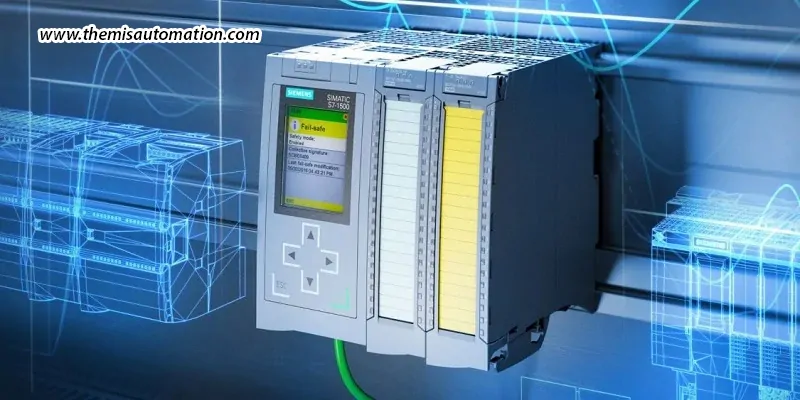
The S7‑1500 series exemplifies Siemens’ high-performance, modular PLC platform. It is intended for medium to high-end machines and complex automation tasks, providing high-speed processing, advanced motion control, and superior diagnostics. The modular architecture facilitates easy expansion with additional CPU and I/O modules, and integration with the Totally Integrated Automation (TIA) Portal guarantees seamless programming, configuration, and system monitoring. This series is extensively utilized in automotive assembly lines, industrial robotics, and advanced packaging systems.
- The S7‑200 SMART series
The S7‑200 SMART series is a micro-PLC designed for cost-sensitive applications or minor automation tasks. It delivers enhanced performance compared to the older S7‑200, featuring a faster CPU, increased memory, and improved communication options. Compact and adaptable, it is well-suited for small machines, water treatment systems, and localized industrial automation projects where efficiency and cost-effectiveness are paramount.
Comparing the three Siemens PLC series
When choosing among the S7‑1200, S7‑1500, and S7‑200 SMART, it is crucial to assess their features regarding application, performance, and scalability.
- Target application: The S7-1200 is well-suited for small to medium-sized machines, the S7-1500 is designed for medium to high-end complex machinery, and the S7-200 SMART is tailored for small, budget-friendly applications.
- Processing speed: The S7-1500 delivers high-speed processing for accurate and intricate operations, while the S7-1200 and S7-200 SMART provide moderate speeds that are appropriate for less complex control tasks.
- Scalability: The S7-1500 features a fully modular design with extensive CPU and I/O expansion capabilities, the S7-1200 allows for modular I/O growth, and the S7-200 SMART offers limited yet sufficient scalability for smaller systems.
- Integrated Technology functions: The S7-1200 includes support for motion control, PID, and communication; the S7-1500 provides advanced motion capabilities, high-speed I/O, and diagnostics; the S7-200 SMART effectively addresses basic automation tasks.
- Communication options: Both the S7-1200 and S7-1500 are compatible with Ethernet and PROFINET, with the S7-1500 also supporting PROFIBUS; the S7-200 SMART features Ethernet for integration within compact or small network configurations.
- Safety features: The S7-1200 and S7-1500 offer failsafe options for operations with higher risks, while the S7-200 SMART has limited safety features that are suitable for low-risk or straightforward automation tasks.
By examining these factors, industrial engineers can determine which PLC best aligns with their project’s complexity, future scalability, and budget constraints.
Factors to consider when selecting a Siemens PLC
Selecting the right Siemens PLC requires careful evaluation of application needs, scalability, communication, safety requirements, budget, and integration with automation systems.
- Application complexity: Assess if your machine or process necessitates basic logic control or advanced motion and processing capabilities.
- Scalability needs: If you foresee future growth, modular PLCs such as the S7‑1500 are recommended.
- Communication requirements: Consider if the system must interface with various devices through PROFINET, PROFIBUS, or Ethernet.
- Safety requirements: For applications that involve operator safety or machine safeguarding, look into failsafe versions.
- Budget constraints: Smaller systems might not warrant high-end PLCs; more economical choices like the S7‑200 SMART are suitable.
- Integration with other Siemens products: Smooth integration with other Siemens products improves control efficiency and minimizes engineering workload.
Selecting the right Siemens PLC depends on the complexity, scalability, and budget of your project. The S7‑1200 is perfect for compact automation tasks, the S7‑1500 is designed for medium to high-end industrial machines, and the S7‑200 SMART is suited for cost-sensitive, small-scale applications. When combined with other Siemens products, these PLCs create a robust automation ecosystem that boosts productivity, reliability, and control in any industrial environment. By understanding the differences and capabilities of these Siemens PLCs, engineers and automation specialists can make well-informed choices, enhancing machine performance and providing dependable industrial solutions.